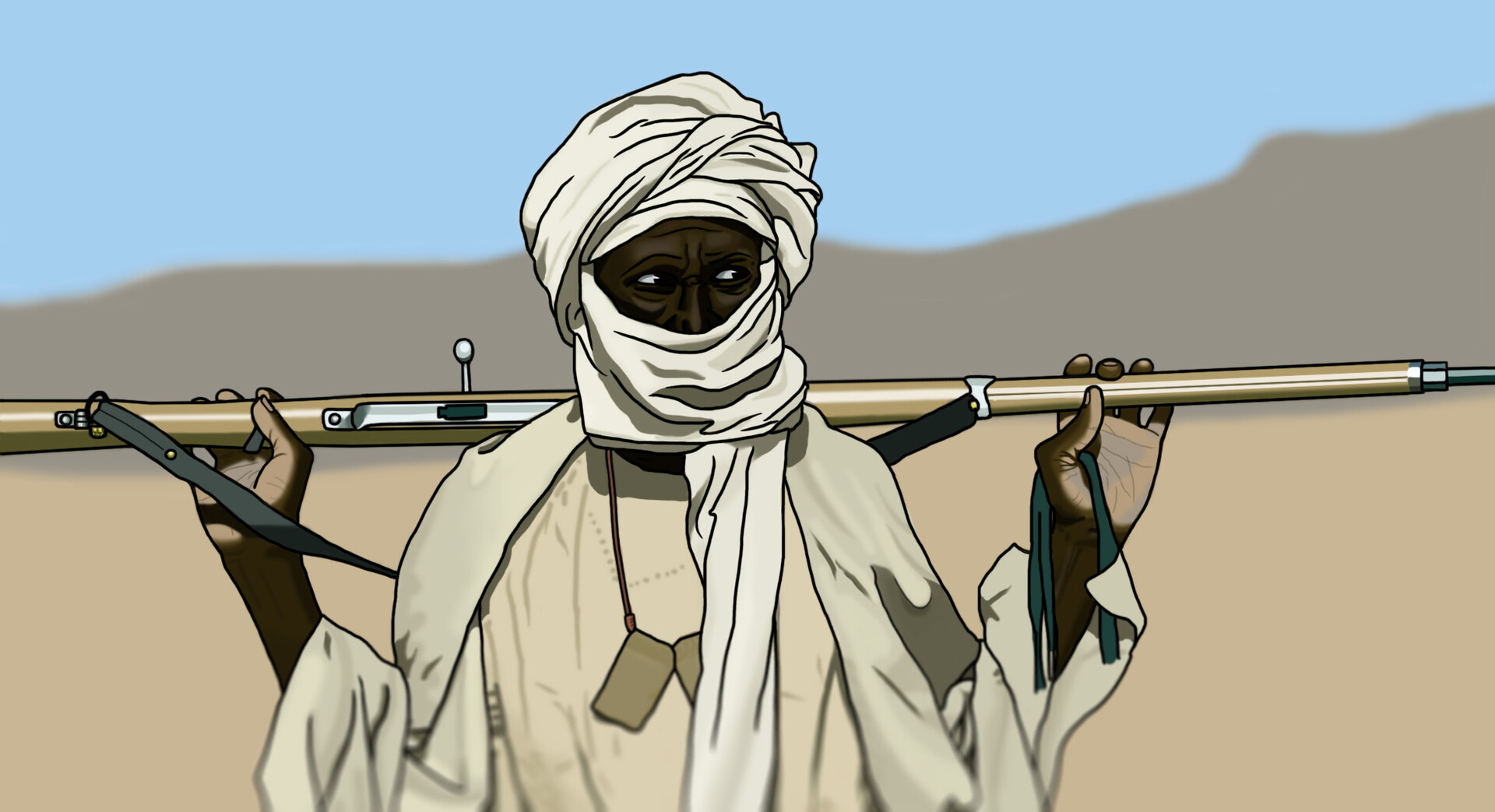
Toubou Warrior
Toubou warrior, after a photograph by Maximilien Bruggmann, northeastern Niger, 1968.
Digital Art Quickie for The African History Channel.
The Toubou are a semi-nomadic central Saharan population inhabiting northern Chad, northeastern Republic of the Niger and southern Libya. They speak the Tebu languages, two dialects spoken by the two groups of Toubou people, the Daza or Dazagara (the southern group) and Teda (the northern group). Tebu languages are related to Kanuri, spoken further to the south. Traditionally they rear camels, goats, cattle, donkeys and sheep, and also practice oasis agriculture, cultivating dates, grains and legumes.
Toubou men wear the litham, which has the appearance of a turban with a face veil. This practice is common among a number of other Saharan and Sahelian populations as well, such as the Tuareg, Sanhaja, Zaghawa, Fulbe, Hausa and Kanuri, but is often misidentified with Arabs.
Toubou people have historically been a highly decentralized people, resistant to all authority above the family and clan levels. They have chiefs, but their chiefs are usually not authority figures who enforce law, but rather elders, advisers or wise men who recite custom and function as mediators and spokespersons.
“Occasionally, a temporary chief will arise in the event of natural disaster or war, but his power lasts only as long as the conditions that necessitate it."